I just made a decision that goes against everything the internet teaches about building a business online. I’m stopping trying to grow my audience.
No new lead magnets. No viral hooks. No “optimizing for reach.” Starting now, I’m focusing entirely on the people already subscribed – writing better stuff for them, responding to every reply, going deeper instead of wider.
The thesis is simple: for a solo founder, a small engaged audience should generate more value than a large passive one. I don’t have proof yet. But the logic is hard to argue with.
Here’s what I mean.
The growth trap
The default solobusiness playbook is built around one assumption: more people equals more money. Grow your email list. Grow your social following. Get more eyeballs on your stuff. The math seems obvious – if 1% of your audience buys, then 10,000 subscribers is better than 1,000.
So you optimize for reach. You write hooks designed to stop strangers mid-scroll. You create content calibrated for the algorithm rather than for the people who already care. You spend your mornings studying what’s trending instead of what’s useful.
I’ve been doing this. The numbers look fine on paper. Follower counts go up. Subscribers trickle in. But something feels off – I’m spending most of my energy attracting new people while barely serving the ones already here.
It’s a treadmill. You’re always running, always creating for an audience that doesn’t know you yet, always chasing the next spike in traffic. And if you’re a solo founder without a team, without a marketing department, without a content calendar managed by five people – that treadmill will grind you down.
The worst part? Nobody tells you that the treadmill is optional.
When your audience grows but your revenue doesn’t
Here’s the math that’s driving this decision.
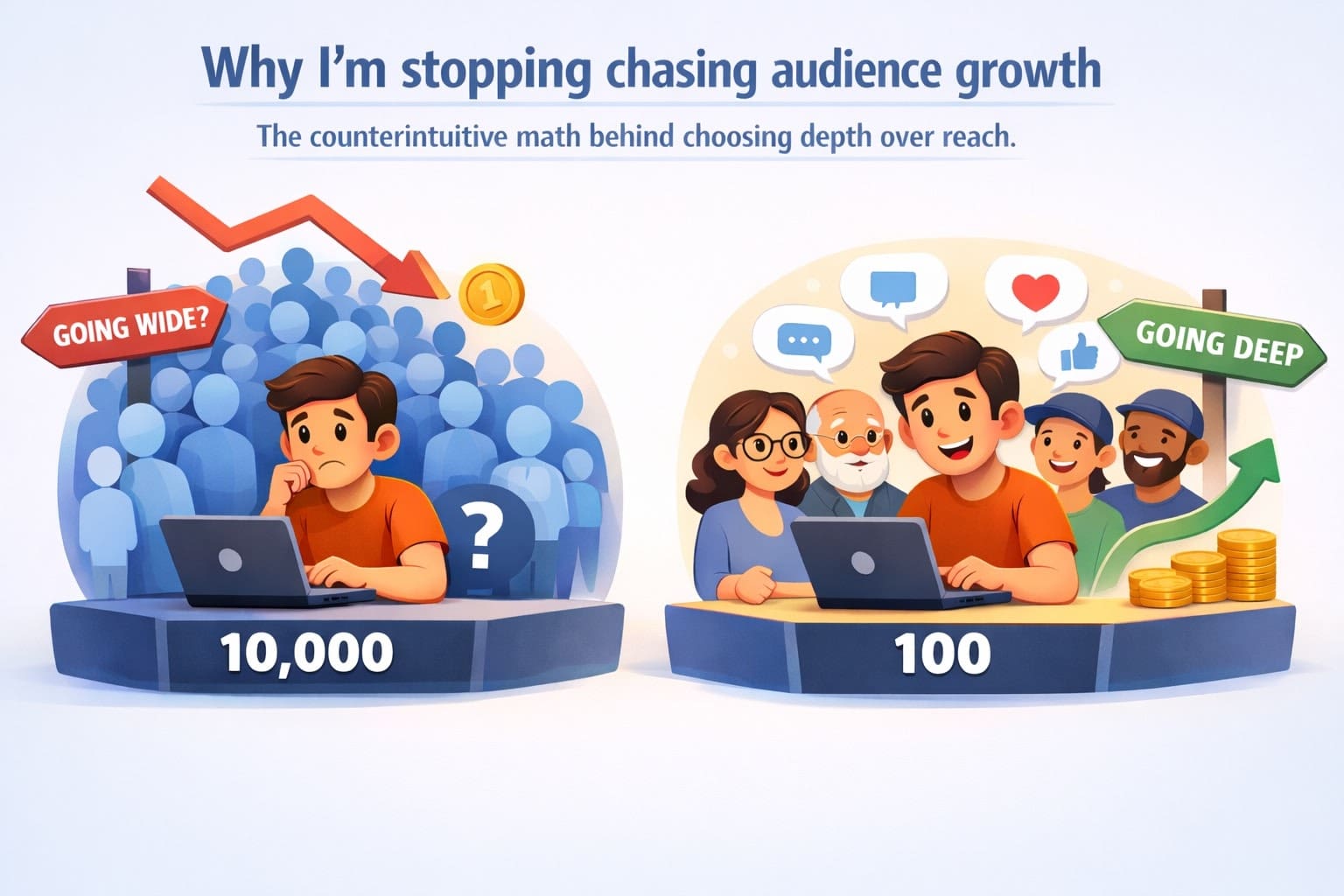
Say you have 10,000 email subscribers. Industry average open rate hovers around 20%. That’s 2,000 people actually reading. Of those, maybe 2% click through to anything. That’s 40 people. And of those, maybe a handful actually buy.
Now say you have 500 subscribers. But these are people who chose to be here. They open at 60%. That’s 300 readers. They click at 10% because they trust you. That’s 30 people. And a much larger share of those 30 converts – because they already know what you do and why it matters.
The second scenario generates comparable revenue with a fraction of the audience. At least in theory. That’s what I’m testing.
For a solo founder, this distinction isn’t academic. You don’t have the infrastructure to serve 10,000 passive followers well. You can’t run the automated sequences, the retargeting ads, the elaborate funnels that make a large passive audience profitable. Those tools exist for teams with budgets.
What you can do – better than almost anyone – is build real relationships with a small group of people. That’s your actual competitive advantage. Not scale. Depth.
Building for depth
I’m not stopping work. I’m redirecting the effort.
Instead of writing hooks for strangers, I’m writing emails that assume the reader already cares about the topic. Instead of creating content designed to be shared, I’m creating content designed to be useful. Instead of tracking new subscriber counts, I’m tracking replies.
The logic behind this shift is that depth creates a feedback loop that reach can never replicate. More replies mean more conversations. More conversations mean I understand what people actually need – not what I assume they need. That understanding makes everything I create more precise, which should make the next round of engagement even stronger.
A thousand passive followers give you vanity metrics. Fifty engaged subscribers give you a product roadmap.
I don’t know if this will work the way I think it will. But the underlying mechanic – that real conversations compound faster than passive attention – feels solid enough to bet on.
Why this feels wrong
I won’t pretend this is comfortable. Every growth-focused instinct I’ve built over the years screams that I’m playing small. That I should be scaling. That the real opportunity is just one viral post away.
The entire culture of online business reinforces this. Follower counts are public. Revenue isn’t. So we optimize for the visible metric – the one that looks good on a screenshot – and ignore the one that actually matters.
But here’s what I keep coming back to: solo founders don’t have a reach problem. We have a capacity problem. Adding more people to an audience you can’t properly serve doesn’t create value. It creates noise.
Playing deep isn’t playing small. It’s playing to your actual strengths. A solo founder who knows 200 subscribers by name, by problem, by situation – that person has something no algorithm can replicate. Something no funded competitor can copy.
That’s not a limitation. That’s an edge.
The question most solo founders ask is “how do I get more people to pay attention?” I think that’s the wrong question.
The better one is: “What would happen if I served my current audience so well that none of them ever wanted to leave?”
I’m running that experiment now. I’ll share what happens.