I self-host my email. I build my own WordPress plugins. I’ve spent weekends configuring servers instead of writing, debugging cookie consent managers instead of shipping products, and building tools that already exist – just so I wouldn’t depend on anyone else’s platform and expensive subscriptions.
I’m an ownership fundamentalist. Or at least, I was.
The principle is sound. Build on land you own. Control your audience. Don’t let an algorithm decide whether your work gets seen. I still believe all of that. But somewhere along the way, the principle stopped serving me and started consuming me.
This is about the line between smart ownership and stubborn self-reliance – and how to tell when you’ve crossed it.
The case for owning everything
Let’s be clear: digital ownership isn’t paranoia. It’s pattern recognition.
If you’ve been online long enough, you’ve watched platforms change their rules overnight. Organic reach on Facebook went from viable to laughable in a few years. Twitter became X and hemorrhaged its creator ecosystem. Google has rewritten its algorithm so many times that entire businesses have evaporated between updates.
When you own your platform – your website, your email list, your content archive – none of that touches you (at least not as much as it does if you rely solely on one of those platforms). Your site doesn’t care about algorithm changes. Your email list doesn’t get throttled by a feed. Your content doesn’t disappear because a company pivoted.
For a solo founder, this matters even more. You don’t have a marketing department to rebuild your strategy when a platform shifts. You don’t have a team to migrate your content overnight. Your digital infrastructure is your business. So owning it makes sense.
I took this seriously. Self-hosted website. Self-hosted email automation. Custom-built plugins for A/B testing, internal linking, SEO. Every tool I could build, I built. Every dependency I could eliminate, I eliminated.
And then I looked at how I was spending my time.
When ownership becomes the trap
Here’s what nobody talks about when they preach digital ownership: maintenance isn’t free.
Every self-hosted tool needs updates. Every custom plugin needs debugging when WordPress releases a new version. Every server needs monitoring, backups, security patches. And every hour spent on infrastructure is an hour not spent on the thing that actually matters – creating value for the people you’re trying to reach.
Self-hosting everything as a solo founder is like growing your own food to avoid grocery stores. Principled, sure. Sustainable? Usually not.
I caught myself spending a full afternoon troubleshooting an email delivery issue that a managed service would have handled automatically. I spent days building a feature that already existed in a $10/month tool. I maintained systems that served my ideology more than they served my audience.
The ownership principle had become its own kind of dependency – a dependency on doing everything myself, at any cost, because renting felt like compromise.
That’s not strategy. That’s stubbornness dressed up as principle.
The pragmatic split
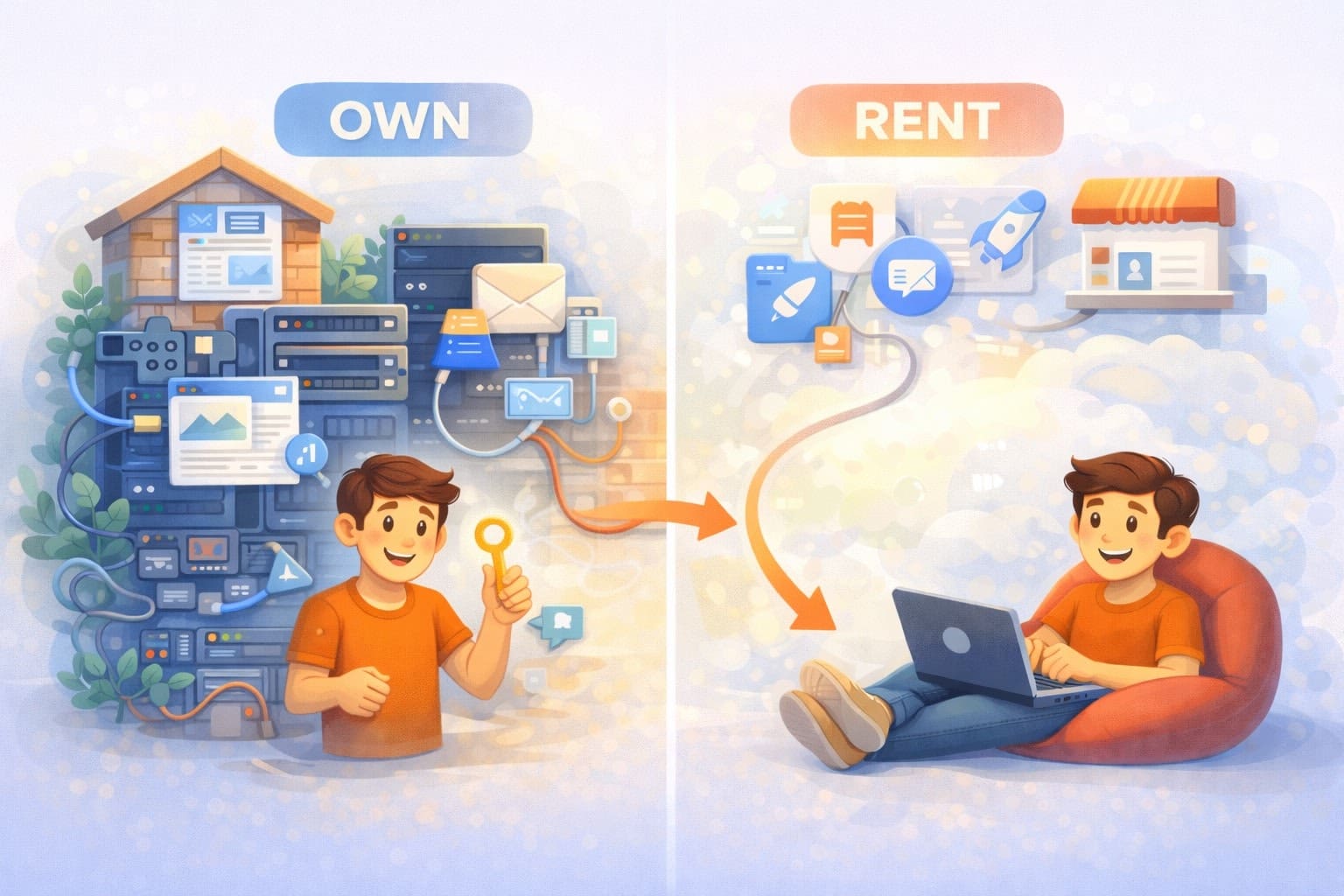
The shift wasn’t abandoning ownership. It was getting specific about what to own.
Not everything carries the same risk. Losing your website is catastrophic. Losing your email list is catastrophic. Losing access to a specific publishing tool? Inconvenient, but survivable.
The question isn’t “should I own everything?” The question is “what must I own, and what can I rent?”
I currently publish on Substack and maintain a self-hosted site. That might look contradictory for someone who preaches ownership. It’s not. It’s the pragmatic split in action.
Here’s why Substack passes the ownership test: it gives you full control over the thing that actually matters – your subscriber list. Every subscriber is reachable via email, directly, without algorithmic filtering or throttled reach. You’re not hoping an algorithm shows your post to 3% of your followers. You’re sending an email to every single person who signed up.
And if you decide to leave? You export your entire list – names, emails, everything – and take it to whatever platform you choose. Mailchimp, Kit, a self-hosted solution, whatever fits. The data is yours. The relationship is yours. Substack just handles the delivery infrastructure.
That’s not renting your audience. That’s using someone else’s distribution while keeping the keys to your own house.
Compare that to building your entire audience on Instagram, where you can’t email your followers, can’t export them, and can’t even guarantee they’ll see your posts. That’s renting without an exit strategy.
The principle isn’t “build everything yourself.” The principle is “never lose access to your audience.”
How to make the split
Before you build or self-host anything, run it through three questions.
Does this touch my core audience relationship? Your email list, your primary content platform, your direct communication channel – these are non-negotiable. Own them.
Would losing access to this break my business? If a tool disappeared tomorrow and your business kept running, you don’t need to own it. You need a good exit plan.
Can I migrate away if I need to? This is the real test. Substack lets you export your subscribers. WordPress lets you export your content. These pass. A platform that locks your data behind a paywall or proprietary format? That’s a trap wearing a feature list.
If all three answers point to “this is critical and I can’t move it” – own it. Build it. Self-host it.
Everything else? Rent it. Use the best tool for the job. Spend your finite energy on work that compounds.
The line
Ownership is a principle, not a religion. The moment it starts costing more than it protects, it’s no longer serving you – it’s owning you.
I still self-host the things that matter. I still build custom tools when no existing solution fits. But I’ve stopped treating every dependency as a failure and started treating strategic renting as what it is: a trade-off made with open eyes.
The real question was never “do I own enough?” It was always “am I building, or am I just maintaining?”
I write about the real trade-offs of building solo – not the inspirational version. If that’s your kind of thing, join the Freymwork.